
Poplar, Eucalyptus, Combi or Finger-Joint Cores Compared
The face film on a shuttering panel is visible in every photograph, but the core is what decides how the panel behaves after the third or fourth pour. Dongstar lists four core options — poplar, eucalyptus, combi and birch — under a face film range that runs from Dynea dark brown film to plastic, with thicknesses at 24 mm at the top of a ramp that starts at 9 mm, with 12, 15, 18 and 21 mm between and a tolerance of ±0.5 mm, as published on the manufacturer's own pages, read 29 Sept 2026.
Key takeaways
- Four cores are published: poplar, eucalyptus, combi and birch, each quoted "or upon request" in place of the others.
- Finger-joint cores are listed separately at 8, 10, 12, 15 and 18 mm, a different band from the 9–24 mm main range.
- Face film choice changes grip and appearance: black, brown, plastic and Anti Slip film all appear on the same specification sheet.
- Sheet sizes of 1220 × 2440 mm — 900 × 2100 mm and as standard 1250 × 2500 mm cover most formwork layouts without a custom cut.
Poplar: the light core that behaves predictably indoors
Poplar is the core most buyers meet first, and the published description explains why: the wood is light, the grain is straight, and the panel is stable and easy to machine. Those three properties matter more in a workshop than in a specification document. A light core reduces the weight a crew lifts at height, and a straight grain means the panel cuts and screws without the wander that softer, mixed grain can produce.
The trade-off is where the panel is used. Poplar is described as suited to interior work such as cabinets and furniture rather than to repeated wet cycles. On a formwork site that distinction is practical: a poplar-cored panel that stays dry and is handled carefully will keep a flat face, while one left standing in water will not. Choosing poplar is therefore a decision about the job, not a judgement about quality.
Eucalyptus: strength and moisture resistance
Eucalyptus sits at the other end of the practical spectrum. The published description credits it with good strength and durability, moisture resistance and a high load-bearing capacity. For a panel that will be stripped and re-used across several pours, or that will sit outdoors between projects, those properties are worth the difference in weight and price.
The pairing that matters most on site is a eucalyptus core with a water-resistant glue line. WBP melamine is published as the resin for wet and exposed service, named for outdoor and marine work, concrete formwork and flooring, while WBP phenolic is published for indoor and outdoor use where heat, chemicals and load are in play, on the strength of its resistance to all three. A eucalyptus core glued with either is a different product from a poplar core glued with the same resin, even when the film on the face is identical.
Combi and birch: two middle paths
Combi is the core that appears when a buyer wants a portion of the performance of a dense species without paying for the whole panel in it. Because it is listed as a third option rather than described in detail, the honest approach is to treat it as a specification to be confirmed per order: ask which species make up the mix and what the target density is, then hold the mill to that answer in writing rather than to the word "combi" on its own.
Birch is the densest core on the list and the one most associated with demanding work. It is heavier, harder and stiffer than poplar, and it is normally specified where screw holding, edge integrity and resistance to repeated handling matter more than weight. In a formwork context the birch core is usually paired with the heavier thicknesses and with the tighter end of the tolerance band, because a heavy panel is expected to carry load rather than simply to face concrete.
Finger-joint construction: a fourth structural option
Finger-joint cores are listed as a grade rather than as a species, and they are quoted at 8, 10, 12, 15 and 18 mm. The construction joins shorter lengths of timber end to end with a profiled joint, which is why the resulting panel behaves differently from one made from a continuous veneer core. The published description ties finger-joint cores to structural integrity in construction, flooring and furniture, crediting them with strength and stability and resistance to warping and cracking.
Reading that list carefully avoids a common error. Finger-joint is not a synonym for the pressed grades; it sits beside them. A buyer comparing a finger-joint panel with a one-time hot press panel of the same thickness is comparing two different assemblies, and the comparison should be made on the job requirement — repeated handling, flatness over a long pour, or cut-edge behaviour — rather than on the label alone.
Films, thickness and the specification line
Face and back options are published as Dynea dark brown film, black film, as a rule, brown film, Anti Slip film plus plastic film across the published range. as standard The notes attached to them are worth keeping: black film is described as offering high contrast, a uniform surface and resistance to water, chemicals and abrasion; brown film as durable and cost-effective for construction; and Anti Slip film as the choice commonly used in workshops to stop vehicles sliding on the panel surface. That last use is a safety decision, not a cosmetic one, and it is usually specified by the site rather than by the buyer.
Thicknesses run at 9, 12, 15, 18, 21 and 24 mm, with sheet sizes at 1220 × 2440 mm or 900 × 2100 mm, and a 1250 × 2500 mm format available on request. Thickness tolerance is published as ±0.5 mm. Certificates published across the range are ISO, CE, CARB and FSC. The panels are manufactured by Dongstar Group, based in Linyi city, China. Together with waterproof edge sealing, which the manufacturer describes as extending panel life by keeping moisture out of the edges, those fields define a reusable shuttering panel far more precisely than the phrase "18 mm film faced" ever will. For anyone buying Film Faced Plywood, core, resin, film and edge treatment together are the specification — the thickness on its own says very little.
| Specification field | Published options | Site consequence |
|---|---|---|
| Core | Poplar, eucalyptus, combi, birch, or upon request | Weight, screw holding, behaviour under moisture |
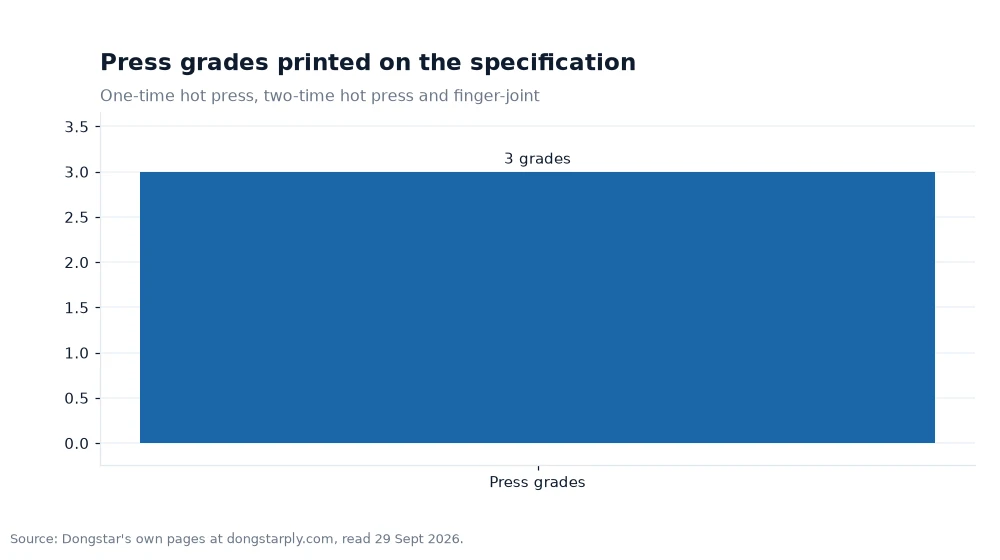
| Grade | One-time hot press, two-time hot press, finger-joint | Number of pours a panel is expected to survive |
| Thickness | 9, 12, 15, 18, 21, 24 mm; finger-joint at 8, 10, 12, 15, 18 mm | Stiffness, weight and form pressure tolerance |
| Sheet size | 1220 × 2440 mm, 900 × 2100 mm or 1250 × 2500 mm; custom sizes on request | Layout efficiency and number of joints |
| Glue line | WBP melamine, WBP phenolic | Indoor, outdoor and marine suitability |
Worked example: working out what a pour actually costs per square metre
A contractor needs to face 900 m² of formwork and is comparing two cores. In the 1220 × 2440 mm format, every sheet works out at 1.22 m × 2.44 m = 2.98 m² (example), so 900 ÷ 2.98 = 302 sheets for a single use, rounded up to 303. If the panel survives four pours, the same 900 m² needs roughly 303 ÷ 4 = 76 sheets per cycle, or 76 sheets purchased if the panels are stripped and re-used cleanly (example).
Run the same figure on the larger format: the 1250 × 2500 mm sheet is 3.125 m² (1.25 m × 2.5 m; example), so 900 ÷ 3.125 = 288 sheets for one use (example). The larger sheet saves fourteen sheets per pass, before any cutting waste is counted. Where the core matters is in the re-use assumption. A poplar-cored panel used dry indoors and a eucalyptus-cored panel glued with a water-resistant resin are not interchangeable when the panel is expected to come back off the wall undamaged, so the re-use number in the calculation should be the one the job supports, not the one the price list implies.
Frequently asked questions
Which core is best for a panel that will be re-used many times?
The published descriptions point to eucalyptus for strength, durability and moisture resistance, and to birch where the heaviest and hardest core is needed. Both matter more when the panel is stripped and re-used than when it faces a single pour.
Do finger-joint cores come in the same thicknesses as the main range?
No. Finger-joint cores are quoted separately at 8, 10, 12, 15 and 18 mm, while the main range runs at 9, 12, 15, 18, 21 and 24 mm with a ±0.5 mm tolerance.
Where does an anti-slip film belong?
Anti Slip film is the option the manufacturer associates with workshop use, where it stops vehicles sliding on the panel surface. It is specified for grip on the walkway or deck rather than for the concrete finish.
Choosing the core before the film
Buyers who want to compare specifications across the range can read how the panel is built on the structural three-ply page, which sets out the veneer structure question in more detail, and then check how a panel system is supported by looking at the group's own background, including the standards work it takes part in. Getting the core and the glue line right first makes the film choice a short conversation.
Core species, grade lists, film options and thickness steps in this article are taken from the maker's own pages, consulted on 29 Sept 2026 — as the basis for this article, as the basis for as standard these notes[1].