
Wholesale Custom Fragrance Projects: A Buyer's Checklist for a US Launch
A wholesale custom fragrance project is a negotiated development agreement with volume attached, not a catalogue order. Buyers who treat it that way — with a written brief, a defined approval reference, and named cost drivers — get quotes that behave predictably at volume; buyers who treat it as a bulk purchase of an existing scent leave both control and money on the table. For a US launch, the checklist below separates projects that scale cleanly from those that stall at the first reorder.
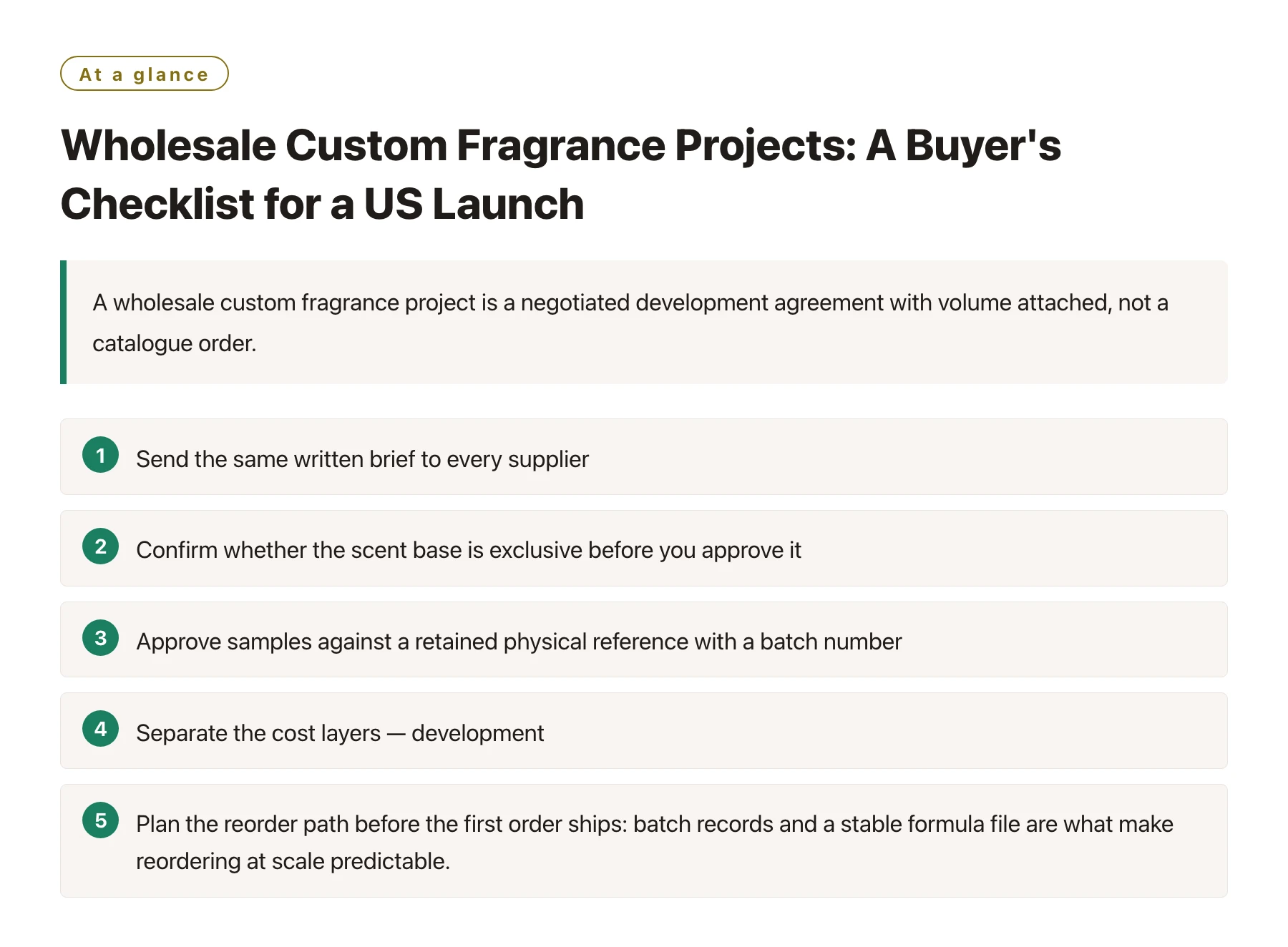
Key takeawaysSend the same written brief to every supplier; wholesale quotes are only comparable when the specification, volume and market are identical. · Confirm whether the scent base is exclusive before you approve it; a shared ODM base costs less but can dilute a launch if a competitor sells the same scent. · Approve samples against a retained physical reference with a batch number, not against an emailed photograph. · Separate the cost layers — development, concentrate, bottle, decoration, freight — because each one behaves differently between sample and bulk. · Plan the reorder path before the first order ships: batch records and a stable formula file are what make reordering at scale predictable.
The wholesale fragrance aisle is full of catalogues: listed scents, listed prices, minimums in the hundreds. But the projects that survive a US launch usually start somewhere else — with a brief, a development conversation, and a set of decisions about the scent itself. The price comes last, because it depends on decisions that have not been made yet.
That is why this checklist puts the negotiation before the number. Work through the points below, and the quote you eventually receive will be one you can compare, defend and plan around.
What a wholesale custom project actually is
A wholesale custom fragrance project sits between two familiar things. It is not a retail catalogue order, because the scent is developed or adjusted around your brief, and it is not a single bespoke commission, because the result is produced in volumes meant for distribution. Understanding how how wholesale custom fragrance projects work matters here: the structure of the project — brief, development rounds, approval, production, reorder — is what you are actually buying, and the price is a function of that structure.
The practical consequence is that everything in this article is about the structure, not the fragrance. A buyer who settles the structure gets a predictable project. A buyer who only negotiates the price gets a surprise somewhere — usually at the reorder stage.
The buyer's checklist, in one place
| Checkpoint | What to settle | Why it matters |
|---|---|---|
| Brief and volume | Category, target market, formats, annual volumes, budget range | Every later number — samples, pricing, lead times — traces back to these |
| Base and exclusivity | Who develops the scent, and whether the base is exclusive to you | A shared base can surface under a competitor's brand after launch |
| Approval reference | A retained physical sample with date and batch number | Photographs and meeting memories do not survive a dispute |
| Cost drivers | Concentrate, bottle, decoration, MOQ, freight, testing | Each layer scales differently; a single blended price hides this |
| Documents | Compliance statement, certificates, label information, SDS | The document pack unlocks customs, retailers and marketplaces |
| Reorder path | Formula file, batch records, price review conditions | A smooth second run is the real test of the first one |
Read the last row first. Most wholesale projects are evaluated on the first run and lived on the reorders.
Where the money goes
Wholesale quotes arrive as a unit price, but the unit price is a blend of layers that behave very differently as volumes change. Development and tooling are paid once. Concentrate scales roughly with dosage and batch size. Bottle and decoration scale with the piece, but their minimums are often larger than the fragrance minimum — a mistake that shows up as a small first run of an expensive bottle.
Concentrate and dosage
One of the first questions to ask is the dosage — the share of fragrance concentrate in the finished product — because it is the largest variable inside the juice. If the factory develops the scent from your brief, you are working in an ODM-style arrangement, and the development partner should be able to explain how the dosage was chosen against the product's price target. A partner like an ODM partner for fragrance brands walks buyers through that trade-off rather than handing over a finished scent with no reasoning attached.
Bottle, decoration and freight
The bottle is often the single biggest piece cost, and decoration — spraying, labelling, hot stamping — adds per-piece time that does not shrink with volume. For a US launch, freight and customs sit on top: air freight is fast and expensive, sea freight needs a longer lead time, and the choice changes how early the production date has to be set.
Testing and documentation
Testing is usually quoted per project or per batch, so it looks small in a unit-price table and can surprise at scale. A responsible buyer plans it into the schedule: stability testing of the finished product in its real packaging, and a compliance statement confirming that the fragrance materials sit within current industry safe-use limits [1]. Third-party testing programmes such as those described in SGS's cosmetics services make the checks auditable rather than self-reported [2].
How the reorder actually works
The first order proves the product; the reorder proves the process. If the factory keeps batch records and the formula file in a state that can be reproduced, the second run is a routine matter. If the first run depended on people's memory, the second run is a new project priced at last run's number.
A manufacturer that keeps custom fragrance R&D and production in one place tends to make the reorder conversation short, because the development notes, the formula file and the production records live in the same system. That is a small thing at sample stage and a large thing at the second container.
One more note for a US launch: scent trends move, but a launch is a commitment. Market research such as the fragrance coverage published by Mintel is useful for judging whether a line has room to sit on shelves for a full season [3] — exactly the horizon a wholesale reorder assumes.
The most expensive mistake in wholesale is treating the project as finished when the sample is approved. The sample is the start of the record — the batch number, the retained reference and the document pack are what make everything after it predictable.
Sources
- IFRA Standards Library (International Fragrance Association) —— The IFRA Standards Library lists the restrictions the fragrance industry applies to individual fragrance ingredients, based on safety assessments; it is the reference point for compliant fragrance formulation.
- SGS: Cosmetics, Personal Care & Household Testing —— Testing, inspection and certification services for cosmetics and personal care, including microbiological, stability and safety testing aligned with cosmetics GMP.
- Mintel Press Centre —— Mintel's press releases on consumer and beauty market research, including fragrance and personal care trend reporting.
Frequently asked questions
What is the difference between wholesale fragrance and private label fragrance?
Wholesale usually implies buying in volume, often of an existing or lightly adapted line. Private label goes further: the product carries your brand, which means your label, your packaging decisions and usually your documentation obligations in the destination market. Many wholesale projects are effectively private label once the branding is yours.
How long does a wholesale custom fragrance project take?
It depends on the path. A project built on an existing base can move from brief to production in a matter of weeks, while a scent developed from a blank brief needs development rounds, a stability window and production lead time. The reliable way to plan is to ask for the schedule as a sequence of approval gates rather than a single date.
What is the minimum order for a custom wholesale fragrance?
Minimums vary by format, bottle and whether you work from an existing base or a new development. Ask for the MOQ per SKU and per format — sprays, roll-ons and home fragrance usually have different minimums — and confirm whether trial quantities can be combined toward a volume order.
Can I keep my wholesale scent exclusive?
Yes, if exclusivity is written into the agreement. Without it, a base developed from a library can be offered to other buyers. Decide this before approving the scent, because after launch it is much harder to negotiate.
Do I need my own trademark before starting a wholesale fragrance project?
You do not need one to start sampling, but a US launch is smoother with a trademark application in place for the name you intend to sell under, since retailers and marketplaces check brand ownership documents at onboarding.