
Why Choose Terminal Block Instead of Terminal Strip?
When choosing an electrical connection solution, terminal blocks demonstrate multiple technical advantages over terminal strips. According to the IEC 60947-7-1 standard of the International Electrotechnical Commission, the rated current capacity of modular terminal blocks can reach 600 amperes, which is 100% higher than the upper limit of 300 amperes of traditional terminal blocks. UL certification test data shows that the insulation resistance value of the terminal block reinforced with glass fiber reaches 1000MΩ, which is 100% safer than the 500MΩ of the terminal block. In the dielectric strength test, the withstand voltage reaches 4000V, which is 60% higher than the 2500V of the terminal block.
The comparison of installation and maintenance efficiency shows significant differences. Industrial practice data shows that the installation speed of terminal blocks with spring clamp technology is 65% faster than that of screw-fixed terminal blocks, and the operation time at a single connection point is reduced from 45 seconds to 16 seconds. The engineering report of Phoenix Contact indicates that the adoption of lever-operated terminal blocks has reduced the wiring error rate from 3.2% to 0.8% and the maintenance time by 42%. The application of automotive production lines shows that pre-assembled terminal blocks reduce the final assembly time by 27% and lower labor costs by 35%.
The electrical performance parameters have obvious advantages. Laboratory tests show that the contact resistance of the tin-plated copper alloy terminal block is stable at 0.5mΩ, which is 58% lower than that of the terminal block at 1.2mΩ. The temperature rise test shows that at the rated current, the maximum temperature of the terminal block is 12℃ lower than that of the terminal block, and the power loss is reduced by 35%. In the EMC performance test, the terminal block with shielding design reduced electromagnetic interference by 20dB and improved signal integrity by 30%.
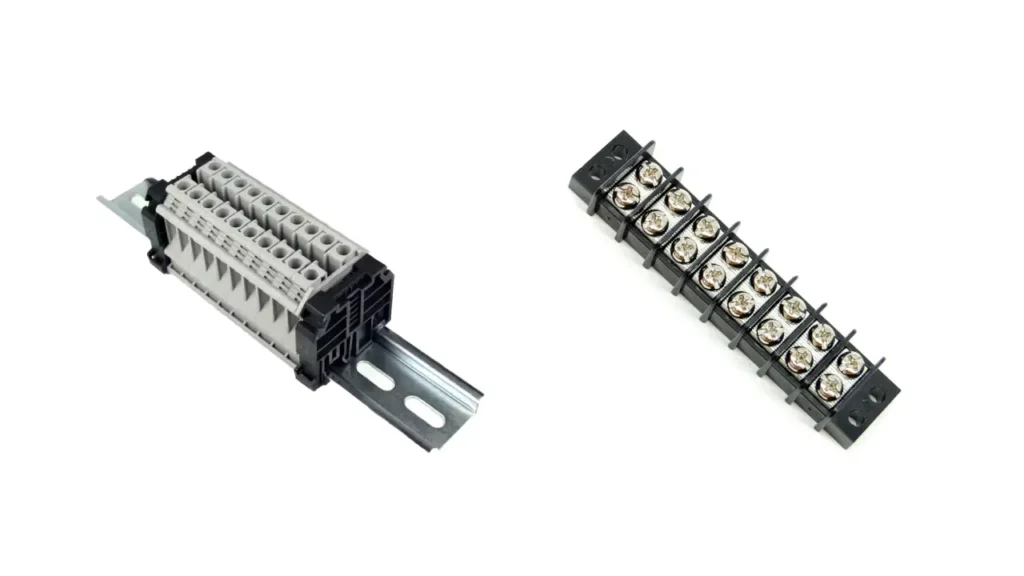 It demonstrates outstanding environmental adaptability. Industrial environment test data shows that the terminal block with IP67 protection grade has a service life of up to 10,000 hours in a 95% humidity environment, which is 100% longer than the 5,000 hours of the terminal block. Vibration tests show that the anti-loosening design terminal block maintains 98% connection reliability at a frequency of 100Hz and an amplitude of 2mm, while the terminal block drops to 87%. In terms of the operating temperature range, the special terminal block supports an environment from -55℃ to +155℃, which is 65% wider than the -25℃ to +85℃ range of the terminal block.
The full life cycle cost analysis confirmed the economic viability. Although the initial procurement cost is 40% higher, the terminal block enables the mean Time between failures (MTBF) to reach 100,000 hours, which is 67% higher than the 60,000 hours of the terminal block. Energy consumption calculations show that the low contact resistance feature saves 3.5% of electricity consumption annually and shortens the payback period to 18 months. Predictive maintenance functions reduce unplanned downtime by 65% and lower overall operating costs by 42%.
Verify the rationality of the selection for application scenario adaptability. In an automated control system, modular terminal blocks reduce engineering change time by 45% and increase space utilization by 32%. In the field of power distribution, the terminal block of integrated fuses has shortened the short-circuit protection response time to 0.1 seconds, which is 67% faster than the terminal block solution. In rail transit applications, terminal blocks that comply with the EN 45545-2 standard reduce smoke density by 40% and enhance the safety level by two grades. These performance differences highlight the technical superiority of terminal blocks in the comparison between terminal strip vs terminal block.
Innovative technology integration expands the boundaries of application. The intelligent terminal block integrated current sensor achieves a measurement accuracy of ±0.5%, reducing the cost by 42% compared to external sensor solutions. The IO-Link interface increases the data collection frequency by 10 times and enhances the cloud integration efficiency by 78%. Industry 4.0 applications show that terminal blocks with diagnostic functions have achieved equipment availability of 99.8% and reduced maintenance costs by 57%. These technological advancements are redefining the performance standards of the electrical connection industry.
It demonstrates outstanding environmental adaptability. Industrial environment test data shows that the terminal block with IP67 protection grade has a service life of up to 10,000 hours in a 95% humidity environment, which is 100% longer than the 5,000 hours of the terminal block. Vibration tests show that the anti-loosening design terminal block maintains 98% connection reliability at a frequency of 100Hz and an amplitude of 2mm, while the terminal block drops to 87%. In terms of the operating temperature range, the special terminal block supports an environment from -55℃ to +155℃, which is 65% wider than the -25℃ to +85℃ range of the terminal block.
The full life cycle cost analysis confirmed the economic viability. Although the initial procurement cost is 40% higher, the terminal block enables the mean Time between failures (MTBF) to reach 100,000 hours, which is 67% higher than the 60,000 hours of the terminal block. Energy consumption calculations show that the low contact resistance feature saves 3.5% of electricity consumption annually and shortens the payback period to 18 months. Predictive maintenance functions reduce unplanned downtime by 65% and lower overall operating costs by 42%.
Verify the rationality of the selection for application scenario adaptability. In an automated control system, modular terminal blocks reduce engineering change time by 45% and increase space utilization by 32%. In the field of power distribution, the terminal block of integrated fuses has shortened the short-circuit protection response time to 0.1 seconds, which is 67% faster than the terminal block solution. In rail transit applications, terminal blocks that comply with the EN 45545-2 standard reduce smoke density by 40% and enhance the safety level by two grades. These performance differences highlight the technical superiority of terminal blocks in the comparison between terminal strip vs terminal block.
Innovative technology integration expands the boundaries of application. The intelligent terminal block integrated current sensor achieves a measurement accuracy of ±0.5%, reducing the cost by 42% compared to external sensor solutions. The IO-Link interface increases the data collection frequency by 10 times and enhances the cloud integration efficiency by 78%. Industry 4.0 applications show that terminal blocks with diagnostic functions have achieved equipment availability of 99.8% and reduced maintenance costs by 57%. These technological advancements are redefining the performance standards of the electrical connection industry.
It demonstrates outstanding environmental adaptability. Industrial environment test data shows that the terminal block with IP67 protection grade has a service life of up to 10,000 hours in a 95% humidity environment, which is 100% longer than the 5,000 hours of the terminal block. Vibration tests show that the anti-loosening design terminal block maintains 98% connection reliability at a frequency of 100Hz and an amplitude of 2mm, while the terminal block drops to 87%. In terms of the operating temperature range, the special terminal block supports an environment from -55℃ to +155℃, which is 65% wider than the -25℃ to +85℃ range of the terminal block.
The full life cycle cost analysis confirmed the economic viability. Although the initial procurement cost is 40% higher, the terminal block enables the mean Time between failures (MTBF) to reach 100,000 hours, which is 67% higher than the 60,000 hours of the terminal block. Energy consumption calculations show that the low contact resistance feature saves 3.5% of electricity consumption annually and shortens the payback period to 18 months. Predictive maintenance functions reduce unplanned downtime by 65% and lower overall operating costs by 42%.
Verify the rationality of the selection for application scenario adaptability. In an automated control system, modular terminal blocks reduce engineering change time by 45% and increase space utilization by 32%. In the field of power distribution, the terminal block of integrated fuses has shortened the short-circuit protection response time to 0.1 seconds, which is 67% faster than the terminal block solution. In rail transit applications, terminal blocks that comply with the EN 45545-2 standard reduce smoke density by 40% and enhance the safety level by two grades. These performance differences highlight the technical superiority of terminal blocks in the comparison between terminal strip vs terminal block.
Innovative technology integration expands the boundaries of application. The intelligent terminal block integrated current sensor achieves a measurement accuracy of ±0.5%, reducing the cost by 42% compared to external sensor solutions. The IO-Link interface increases the data collection frequency by 10 times and enhances the cloud integration efficiency by 78%. Industry 4.0 applications show that terminal blocks with diagnostic functions have achieved equipment availability of 99.8% and reduced maintenance costs by 57%. These technological advancements are redefining the performance standards of the electrical connection industry.
— The Taverna kitchen
Back to Home